

They were already sitting inside the wire, quietly minding their business, until something reached them almost instantly telling them to move.
Something faster than any electron could travel physically.
So what’s really carrying the energy? The wire… or the space around it, Because in this case something commanding electrons to move is like transmitting energy to electrons.
Empty space. We say that so casually. But how can emptiness carry anything?
Newton asked the same question: how does Earth reach across empty space to pull the Moon? Different phenomenon, same puzzle: how can “influence” travel without contact?
For centuries Philosophers and Physicists used to believe in this idea that objects could only influence each other by touching. Newton called this puzzle ‘action at a distance.’ Even he was unsettled that influence could somehow travel through empty space without anything physical connecting the objects.
The world at a distance acts in ways that can’t be explained by particles merely pushing each other.
Faraday ignored the cold mathematics of ‘action on at a distance.’ Instead, he visualized a hidden geometry filling the void.
Think about walking into a room. Near the heater, it’s warm. Near the window, it’s cool. Every point in space has a value.
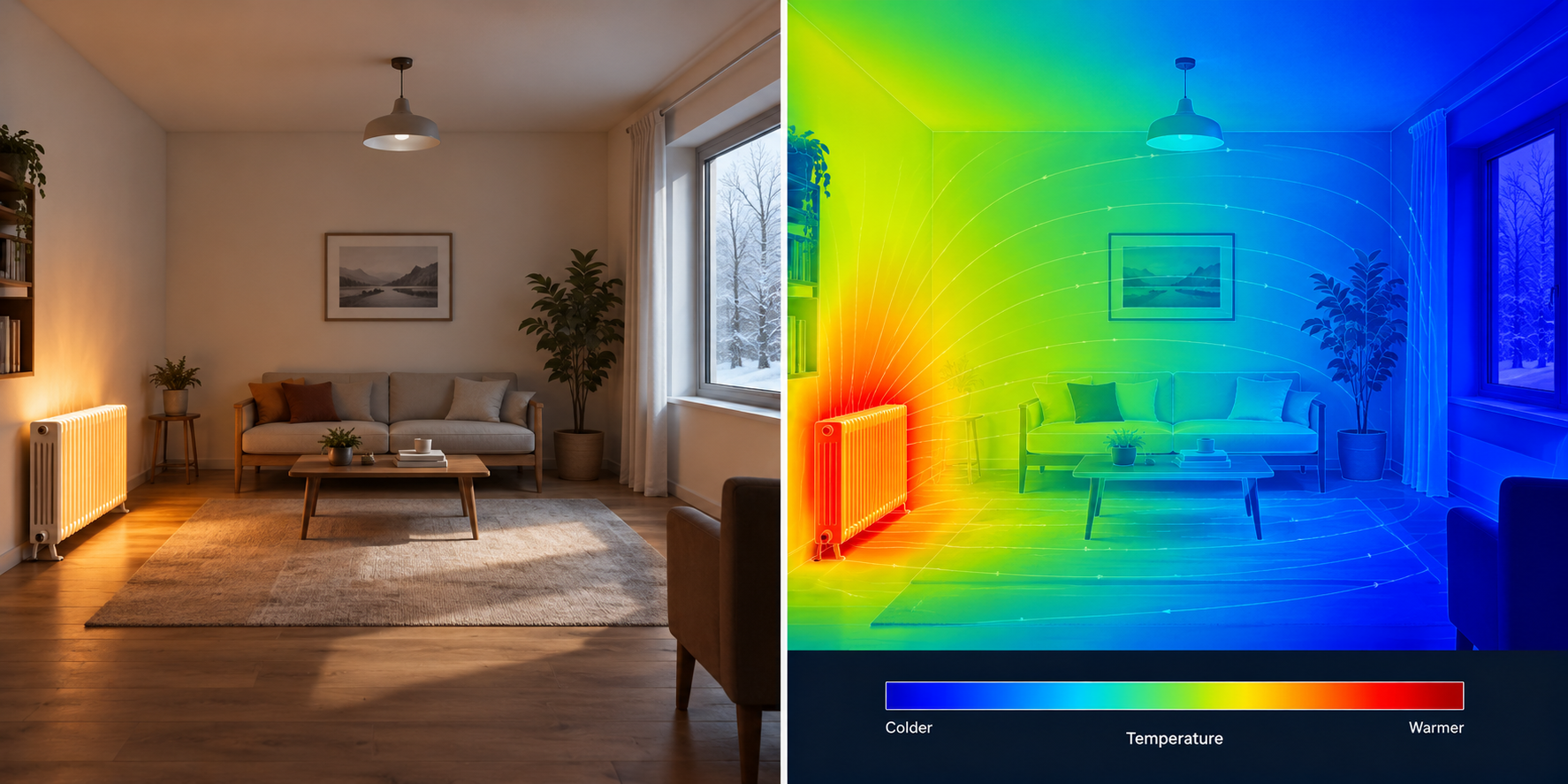
The same room described in two ways: what we see, and the value assigned to every point in space.
A charge doesn't reach across empty space to push or pull. It reshapes the space around it, creating what faraday called field. Other charges don't respond to the charge itself; they respond to that reshaped space, “the field”.
Place a positive charge somewhere it creates an electric field pointing outwards, creating a push effect. On the other hand, place an electron (negative charge) somewhere, it creates an electric field pointing inwards, creating that pull effect. That’s why you observe “like” charges repel and “unlike” attract.
Two like charges repel — but both answer to the one opposite charge between them.